Accessible route planning
Wheelchair routing that accounts for ramps, kerbs and step-free access, and steers around barriers other users have reported. Car and transit modes included.
Move My Way helps wheelchair users find accessible venues and step-free routes across Malaysia, powered by real reports from real people who have actually been there.
Free to use · Runs in your browser, nothing to install · Built for Malaysia
For a wheelchair user in Malaysia, a "quick trip" often starts with a list of unknowns. Is there a ramp at the entrance, or three steps? Is the lift working today? Is the accessible toilet actually open, or being used as a store room?
Standard navigation apps were never built to answer those questions. They optimise for the shortest path, not the passable one. Move My Way was built for exactly that gap.


Accessibility isn't a filter bolted onto a map. It runs through routing, venue data, reporting and rewards as one connected loop.
Wheelchair routing that accounts for ramps, kerbs and step-free access, and steers around barriers other users have reported. Car and transit modes included.
Every venue carries a computed accessibility score built from its features, and every feature can be confirmed or disputed by the people who actually visit.
Blocked ramp, broken lift, motorbikes on the kerb cut? Report it in seconds with a photo and a pin, and it appears on everyone else's map straight away.

A four-language assistant, by voice or text, that answers from your real trips and the real venue data. It needs mobile data or Wi-Fi to answer.
Scroll, the phone keeps up. Or tap any step to jump straight to that screen.
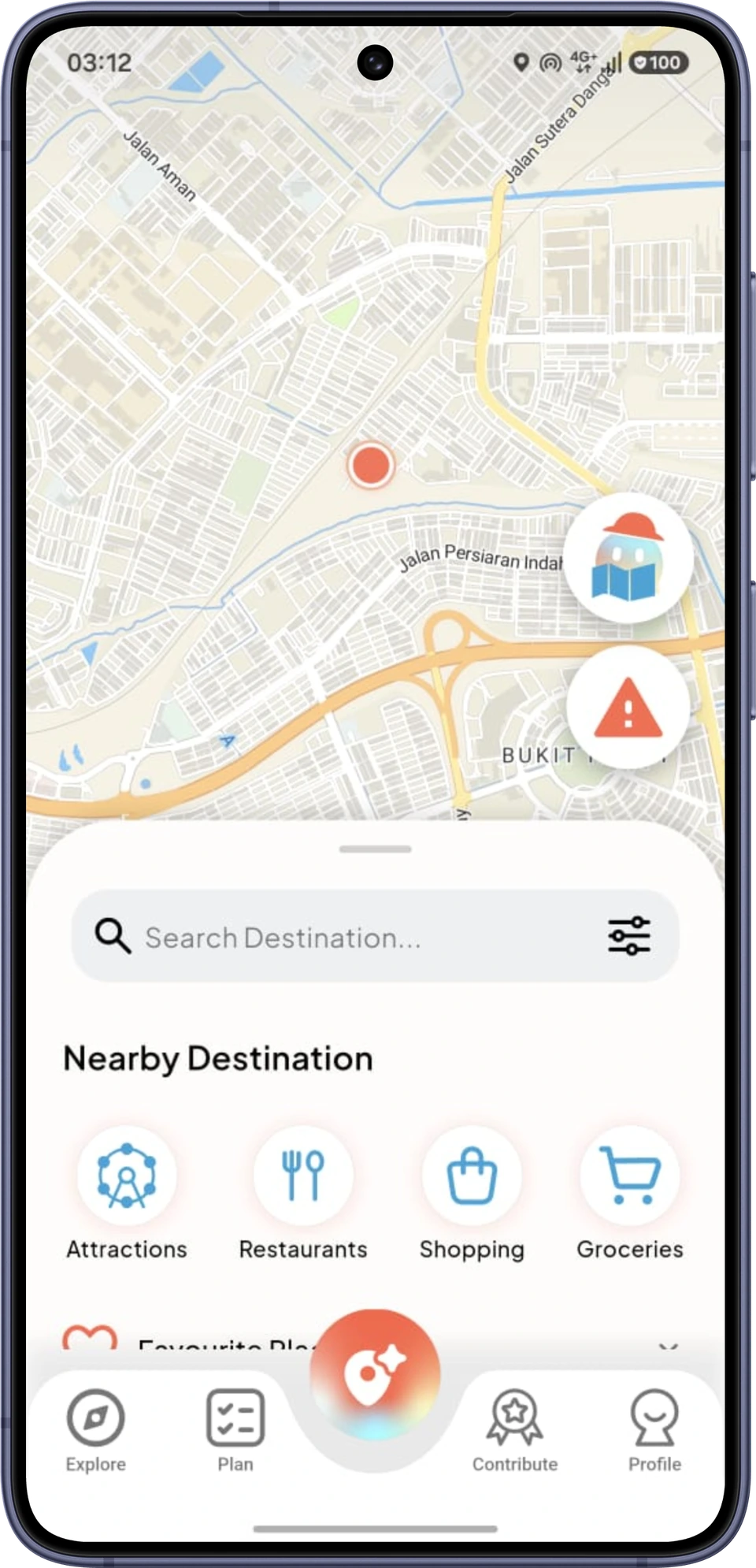
The app opens on a map of your area with your position marked. Search for a place by name, or tap a category, Attractions, Restaurants, Shopping or Groceries, to see what is nearby.
Every place carries an accessibility percentage, a plain-language rating, its opening hours and photos, so you can decide whether it is worth the trip without phoning ahead.
Turn-by-turn navigation shows the distance to your next turn, your arrival time and current road conditions. Voice guidance reads each turn aloud as you travel.
Found a problem? Choose from six barrier types: a blocked ramp, a crowded area, a broken lift, an obstructed pathway, an inaccessible toilet or a hard-to-open door.
This is the Move My Way mobile app itself, running on the same live database, not a video or a set of screenshots. Search venues, read accessibility scores, plan a trip and ask Compass AI — from your laptop or your phone’s browser.
Pick how it should use your screen: the phone layout shows it exactly as on a smartphone, and the desktop layout adds a sidebar and a full-size map beside the app.
Sign up with an email address to try every feature. AR walking guidance and Google, Apple or Facebook sign-in need the mobile app.
Works in Chrome, Edge, Safari and Firefox — on a laptop or a phone.
Scan the QR code to watch a video showing the app’s features and how to use it.

Point your phone camera at the code.
Every number below is live in the production database that the app and the admin console both read from.
Accessibility data is only worth having if it is true, so the AI here does two narrow jobs: answer from real data, and keep junk photos off the map.
The app is currently free to use. Rewards are paid for entirely with points earned in the app, and there is no payment gateway anywhere in the product.
Every venue starts from a researched baseline record, then the community refines it. Users vote on whether each feature is actually present, and a majority vote updates the venue's stored features, which recomputes its score. Barrier reports from the last 30 days within 150 metres also pull the score down.
There is, and it doesn't. Compass answers questions in four languages by voice or text, and a separate vision check screens barrier photos before they are submitted. Both are included, with nothing to pay and no subscription or credit system anywhere in the app. Read how it works.
Yes. Submit your details on the Register Your Venue page and it goes into a review queue for our team. Listings are verified by a human before they go live, we don't auto-publish self-reported accessibility claims.